Peter Vintage Car Restoration Dan Contract $100000 Art June 1
| Republic of Indonesia Republik Indonesia (Indonesian) | |||||||||||
|---|---|---|---|---|---|---|---|---|---|---|---|
| 1966–1998 | |||||||||||
| Flag National Keepsake | |||||||||||
| Motto: Bhinneka Tunggal Ika (Kawi) (English: "Unity in Diversity") Sole land ideology: Pancasila [1] [two] | |||||||||||
| Anthem:Indonesia Raya (English: "Swell Republic of indonesia") | |||||||||||
 Map of Indonesia in 1978 | |||||||||||
| Majuscule and largest city | Dki jakarta half dozen°ten′Southward 106°49′East / 6.167°S 106.817°E / -6.167; 106.817 | ||||||||||
| Official language and national language | Indonesian | ||||||||||
| Regional languages | Over 700 languages | ||||||||||
| Religion |
| ||||||||||
| Demonym(s) | Indonesian | ||||||||||
| Government | Unitary presidential constitutional commonwealth under an disciplinarian military dictatorship
| ||||||||||
| President | |||||||||||
| • 1966-1967 | Sukarno | ||||||||||
| • 1967-1998 | Suharto | ||||||||||
| Vice President | |||||||||||
| • 1956-1973 | Vacant [a] | ||||||||||
| • 1973-1978 | Hamengkubuwono IX | ||||||||||
| • 1978-1983 | Adam Malik | ||||||||||
| • 1983-1988 | Umar Wirahadikusumah | ||||||||||
| • 1988-1993 | Sudharmono | ||||||||||
| • 1993-1998 | Try Sutrisno | ||||||||||
| • 1998 | B. J. Habibie | ||||||||||
| Legislature | Provisional People'due south Consultative Assembly (1966–1973) People's Consultative Assembly (1973–1998) | ||||||||||
| • Upper house | "Regional delegates" (1973–1998) | ||||||||||
| • Lower firm | People'due south Representative Council of Mutual Aid (1966–1973) People's Representative Council (1973–1998) | ||||||||||
| Historical era | Cold State of war | ||||||||||
| • Supersemar | 11 March 1966 | ||||||||||
| • Suharto presidency began | 12 March 1967 | ||||||||||
| • Inauguration of Suharto | 27 March 1968 | ||||||||||
| • Invasion of Eastward Timor | seven December 1975 | ||||||||||
| • May 1998 riots | 12-xv May 1998 | ||||||||||
| • Fall of Suharto | 21 May 1998 | ||||||||||
| Area | |||||||||||
| 1992[c] | one,919,440 km2 (741,100 sq mi) | ||||||||||
| Population | |||||||||||
| • 1992[c] | 195,683,531 | ||||||||||
| Currency | Rupiah | ||||||||||
| ISO 3166 code | ID | ||||||||||
| |||||||||||
| Today part of |  Indonesia Indonesia  Democratic republic of timor-leste Democratic republic of timor-leste | ||||||||||
| |||||||||||



The New Social club (Indonesian: Orde Baru, abbreviated Orba) is the term coined by the second Indonesian President Suharto to characterise his administration equally he came to power in 1966 until his resignation in 1998. Suharto used this term to contrast his presidency with that of his predecessor Sukarno (retroactively dubbed the "Old Social club," or Orde Lama).
Immediately post-obit the attempted coup in 1965, the political state of affairs was uncertain, Suharto's New Social club plant much popular support from groups wanting a separation from Indonesia's problems since its independence. The 'generation of 66' (Angkatan 66) epitomised talk of a new group of young leaders and new intellectual thought. Post-obit Indonesia's communal and political conflicts, and its economic collapse and social breakdown of the late 1950s through to the mid-1960s, the "New Gild" was committed to achieving and maintaining political lodge, economical evolution, and the removal of mass participation in the political process. The features of the "New Order" established from the late 1960s were thus a strong political role for the military, the bureaucratisation and corporatisation of political and societal organisations, and selective only effective repression of opponents. Strident anti-communist doctrine remained a hallmark of the presidency for its subsequent 32 years, with Islamism becoming prevalent in the early 1990s.
Within a few years, however, many of its original allies had become indifferent or averse to the New Order, which comprised a war machine faction supported by a narrow civilian group. Among much of the pro-republic movement which forced Suharto to resign in the 1998 Indonesian Revolution and then gained power, the term "New Lodge" has come to be used pejoratively. It is frequently employed to describe figures who were either tied to the Suharto period, or who upheld the practises of his authoritarian assistants, such as abuse, collusion and nepotism (widely known by the acronym KKN: korupsi, kolusi, nepotisme).[4]
Groundwork [edit]
Sukarno was Republic of indonesia's founding president, a position he had held since the Democracy'south formation in 1945. In 1955, the first general parliamentary elections delivered an unstable parliament and from the late 1950s, Sukarno's rule became increasingly autocratic under his "Guided Republic". Described equally the neat "dalang", Sukarno's position depended on his concept of NASAKOM (Nationalism, Religion, Communism) whereby he sought to residual the competing Indonesian Military, Islamic groups, and the increasingly powerful Indonesian Communist Party (PKI). To the resentment of the Military machine and Muslim groups, this arrangement became increasingly reliant on the PKI which had become the country's strongest political party.
Sukarno'southward anti-royal ideology saw Indonesia increasingly dependent on the Soviet Wedlock and Prc which was met with indignation from Western countries. The cash-strapped government had to scrap public sector subsidies, annual inflation rose to equally high as 1,000%, export revenues were shrinking, infrastructure crumbling, and factories were operating at minimal capacity with negligible investment. Sukarno'due south assistants became increasingly ineffective in providing a viable economic organisation to lift its citizens out of poverty and hunger. Meanwhile, Sukarno led Indonesia into Konfrontasi, a armed services confrontation with Malaysia, removed Republic of indonesia from the United Nations, and stepped up revolutionary and anti-Western rhetoric.[5]
By 1965 at the tiptop of the Cold State of war, the PKI penetrated all levels of government. With the support of Sukarno and the Air Strength, the political party gained increasing influence at the expense of the Army, thus ensuring the Regular army's enmity.[vi] Muslim clerics, many of whom were landowners, felt threatened by the PKI's rural state confiscation actions. The regular army was alarmed at Sukarno'due south support for the PKI's wish to chop-chop plant a "fifth force" of armed peasants and labourers,[seven] which was beginning announced by the PKI to a CBS News journalist. Calculation to this desperate and fractious nature of Republic of indonesia in the 1960s, a split within the military was fostered by Western countries backing a right-fly faction against a left-wing faction backed by the PKI.[8]
Overthrow of Sukarno [edit]
On thirty September 1965, half-dozen generals were killed by a group calling themselves the thirty September Movement who alleged a right-wing plot to kill the President. General Suharto led the regular army in suppressing the abortive coup attempt. The PKI were chop-chop blamed and the regular army led an anti-communist purge which killed an estimated 500,000 to a million people.[nine] [10] Public opinion shifted against Sukarno in part due to his credible knowledge of, and sympathy for, the events of 30 September, and for his tolerance of leftist and communist elements whom the army blamed for the coup endeavor. Student groups, such as KAMI, were encouraged by, and sided with, the Army confronting Sukarno. In March 1966, Suharto secured a presidential decree (known as the Supersemar), which gave him authorization to take any action necessary to maintain security.[11] Using the decree, the PKI was banned in March 1966 and the parliament (MPRS), authorities and military were purged of pro-Sukarno elements, many of whom were defendant of being communist sympathisers, and replaced with Suharto supporters.[12]
A June session of the now-purged parliament promulgated a parliamentary resolution irrevocable by Sukarno (Tap MPRS no. XXV/MPRS/1966), that confirmed Suharto'south ban of the PKI and simultaneously banned "Communism/Marxism-Leninism" (sic; explicitly defined in the resolution'south corresponding explanatory memorandum to include "the struggle fundaments and tactics taught by ... Stalin, Mao Tse Tung et cetera"), also as promulgating other resolutions that elevated the Supersemar into a parliamentary resolution also irrevocable by Sukarno, and stripped Sukarno of his title of president for life. In August–September 1966, and confronting the wishes of Sukarno, the New Social club concluded Republic of indonesia's confrontation with Malaysia and rejoined the United Nations. Parliament re-convened in March 1967 to impeach the President for his apparent toleration of thirty September Movement and violation of the constitution past promoting PKI's international communist agenda, negligence of the economic system, and promotion of national "moral degradation" via his womanising behaviour. In March 1967, the MPRS stripped Sukarno of his remaining power, and Suharto was named Acting President.[xiii] Sukarno was placed nether house arrest in Bogor Palace; piddling more was heard from him, and he died in June 1970.[14] In March 1968, the MPRS appointed Suharto to the starting time of his v-yr terms as President.[15]
Consolidation of power [edit]


Suharto took the presidential oath of office, 27 March 1968.
The "New Order" was so called to distinguish and "better" itself from Sukarno's "Old Order". Pancasila was promoted equally the national ideology, one that pre-dated introduced religions such equally Hinduism or Islam.[16] Suharto secured a parliamentary resolution in 1978 (Tap MPR No. II/1978) which obliged all organisations in Republic of indonesia to adhere to Pancasila as a basic principle. He instituted a Pancasila indoctrination program that must be attended by all Indonesians, from master school students to office workers.[16] Pancasila, a rather vague and generalist set up of principles originally formulated past Sukarno in 1945, was vigorously promoted as a sacrosanct national ideology which represents the ancient wisdom of Indonesian people even before the entry of foreign-based religions such every bit Hinduism or Islam. In a July 1982 speech which reflected his deep infatuation with Javanese behavior, Suharto glorified Pancasila as a key to accomplish the perfect life (ilmu kasampurnaning hurip) of harmony with God and boyfriend mankind.[16] In practice, however, the vagueness of Pancasila was exploited by Suharto'southward government to justify their actions and to condemn their opponents as "anti-Pancasila".[sixteen]
The Dwifungsi ("Dual Function") policy allowed the military to have an active role in all levels of Indonesian regime, economy, and society.
Neutralisation of internal dissent [edit]
Having been appointed president, Suharto notwithstanding needed to share power with various elements including Indonesian generals who considered Suharto as mere primus inter pares as well as Islamic and student groups who participated in the anti-communist purge. Suharto, aided past his "Office of Personal Administration" (Aspri) clique of military officers from his days as commander of Diponegoro Division, particularly Ali Murtopo, began to systematically cement his concord on power past subtly sidelining potential rivals while rewarding loyalists with political position and monetary incentives.
Having successfully stood-downwards MPRS chairman General Nasution'southward 1968 effort to introduce a beak which would have severely curtailed presidential authority, Suharto had him removed from his position equally MPRS chairman in 1969 and forced his early retirement from the armed services in 1972. In 1967, generals Hour Dharsono, Kemal Idris, and Sarwo Edhie Wibowo (dubbed "New Order Radicals") opposed Suharto's conclusion to allow the participation of existing political parties in elections in favour of a not-ideological ii-party arrangement somewhat similar to those institute in many Western countries. Suharto so proceeded to send Dharsono overseas as administrator, while Kemal Idris and Sarwo Edhie Wibowo were sent to distant North Sumatra and South Sulawesi as regional commanders.[17]
While many original leaders of the 1966 student movement (Angkatan 66) were successfully co-opted into the government, it faced large pupil demonstrations challenging the legitimacy of the 1971 elections, the Golput Movement, the costly construction of Taman Mini Republic of indonesia Indah theme park (1972), the domination of foreign capitalists (Malari Incident of 1974), and the lack of term limits of Suharto'southward presidency (1978). The New Gild responded by imprisoning educatee activists and sending army units to occupy the campus of the Bandung Establish of Technology in 1978. In April 1978, Suharto ended the campus unrest past issuing a prescript on the "Normalization of Campus Life" (NKK) which prohibited political activities on-campus not related to academic pursuits.[18] [nineteen]
In 1980, l prominent political figures signed the Petition of L which criticised Suharto's use of Pancasila to silence his critics. Suharto refused to address the petitioners' concerns, and some of them were imprisoned with others having restrictions imposed on their movements.[20]
Domestic politics and security [edit]
Depoliticization [edit]
To placate demands from civilian politicians for the holding of elections, as manifested in MPRS resolutions of 1966 and 1967, Suharto government formulated a series of laws regarding elections every bit well as the structure and duties of parliament which were passed by MPRS in Nov 1969 afterwards protracted negotiations. The constabulary provided for a parliament (Madjelis Permusjawaratan Rakjat/MPR) with the ability to elect presidents consisting of a lower house (Dewan Perwakilan Rakjat/DPR) too as regional and groups representatives. 100 of the 460 members of DPR were soldiers of the Republic of indonesia Armed services (ABRI)—mostly Indonesian Regular army soldiers—directly appointed by the government equally part of Dwifungsi, while the remaining seats were allocated to political parties based on results of a general election. This mechanism ensures pregnant government command over legislative affairs, specially the appointment of presidents.[21] [22]
To participate in the elections, Suharto realised the need to align himself with a political political party. Later initially because alignment with Sukarno's quondam party, the PNI, in 1969 Suharto took control of an obscure military-run federation of NGOs chosen Golkar ("Functional Grouping") and transform it into his electoral vehicle under the co-ordination of his right-hand homo Ali Murtopo. The first general election was held on 3 July 1971 with ten participants: Golkar, 4 Islamic parties, as well as five nationalist and Christian parties. Campaigning on a non-ideological platform of "evolution", and aided by official government back up and subtle intimidation tactics. Golkar secured 62.eight% of the popular vote. The March 1973 general session of the MPR promptly appointed Suharto to a second term in office with Sultan Hamengkubuwono IX as vice-president.[23]
On 5 January 1973, to allow better control, the government forced the four Islamic parties to merge into the PPP (Partai Persatuan Pembangunan/United Development Party) while the five not-Islamic parties were fused into PDI (Partai Demokrasi Indonesia/Indonesian Democratic Political party). The regime ensured that these parties never developed constructive opposition by controlling their leadership, while establishing the "re-call" system to remove any outspoken legislators from their positions. Using this system dubbed the "Pancasila Democracy", Golkar won the MPR general elections of 1977, 1982, 1987, 1992, and 1997 with massive landslides. The elected MPR and so proceeded to unanimously re-elect Suharto every bit president in 1978, 1983, 1988, 1993, and 1998.[24]
Institution of corporative groups [edit]
Suharto proceeded with social applied science projects designed to transform Indonesian society into a de-politicized "floating mass" supportive of the national mission of "development", a concept similar to corporatism. The government formed civil gild groups to unite the populace in support of government programs. For instance, the government created and required all civil servants and employees of state- and local government-owned enterprises and those of Banking company Indonesia to join KORPRI (the Employees' Corps of the Republic of Indonesia) in November 1971 to ensure their loyalty;[note 1] organised the FBSI (Federasi Buruh Seluruh Indonesia) as the simply legal labour union for workers non eligible for KORPRI membership in February 1973 (after renamed equally SPSI/Serikat Pekerja Seluruh Republic of indonesia in 1985), established under the pretext of tripartism, officially defined equally Pancasilaist Industrial Relations (Indonesian: Hubungan Industrial Pancasila) (while in fact it cements only business interests with the state); and established the MUI (Majelis Ulama Republic of indonesia) in 1975 to control Islamic clerics. In 1966 to 1967, to promote assimilation of the influential Chinese Indonesians, the Suharto government passed several laws every bit part of the so-called "Basic Policy for the Solution of Chinese Problem", whereby only one Chinese-language publication (controlled by the army) was allowed to continue, all Chinese cultural and religious expressions (including display of Chinese characters) were prohibited from public space, Chinese schools were phased out, and the ethnic Chinese were encouraged to take Indonesian-sounding names. Furthermore, Chinese Indonesians are also subject to the Certificate of Citizenship in order to enter an university, obtain a passport, annals for an election, and to get married. In 1968, Suharto commenced the very successful family planning plan (Keluarga Berentjana/KB) to stem the huge population growth charge per unit and hence increase per-capita income. A lasting legacy from this period is the spelling reform of Indonesian language decreed by Suharto on 17 August 1972.[25]
"Country Ibuism" [edit]
Inspired by Javanese civilization of priyayi, the New Order, during its consolidation era, was antifeminist and patriarchic, and officially defined as "familyism" (Indonesian: kekeluargaan). In 1974, President Suharto established ceremonious retainer wives' corps Dharma Wanita, organized under the doctrine of "Five Women'due south Dharma" (Indonesian: Pancadharma Wanita, an antifeminist, patriarchic doctrine[ commendation needed ] like to Nazi Germany'due south Kinder, Küche, Kirche); a "Family Welfare Training" programme (Indonesian: Pembinaan Kesejahteraan Keluarga, PKK), which was rooted on a 1957 conference on home economics in Bogor, was made compulsory in 1972, specially on rural regions.
Information technology wasn't until 1980 that feminism would gain an uprising with the establishment of several foundations, for instance the Annisa Shanti foundation (Yasanti).
Political stability [edit]
Suharto relied on the military to ruthlessly maintain domestic security, organised by the Kopkamtib (Performance Command for the Restoration of Security and Lodge) and BAKIN (Country Intelligence Coordination Agency). To maintain strict control over the state, Suharto expanded the regular army'south territorial system downwardly to the village level, while war machine officers were appointed every bit regional heads under the rubric of the Dwifungsi ("Dual Function") of the military. By 1969, 70% of Indonesia's provincial governors and more half of its commune chiefs were active armed services officers. Suharto authorised Operasi Trisula which destroyed PKI remnants trying to organise a guerrilla base of operations in the Blitar area in 1968 and ordered several armed forces operations which concluded the communist PGRS-Paraku insurgency in West Kalimantan (1967–1972). Attacks on oil workers by the offset incarnation of Free Aceh Move separatists nether Hasan di Tiro in 1977 led to dispatch of modest special forces detachments who quickly either killed or forced the move'due south members to flee abroad.[26] Notably, in March 1981, Suharto authorised a successful special forces mission to end hijacking of a Garuda Indonesia flight past Islamic extremists at Don Muang Airport in Bangkok.[27]
To comply with the New York Agreement of 1962 which required a referendum on integration of West Irian into Indonesia earlier terminate of 1969, the Suharto government began organising for a so-called "Human action of Free Choice" (PEPERA) scheduled on July–August 1969. The authorities sent RPKAD special forces nether Sarwo Edhie Wibowo which secured the surrender of several bands of the sometime Dutch-organized militia (Papoea Vrijwilligers Korps/ PVK) at big in the jungles since the Indonesian takeover in 1963, while sending Catholic volunteers under Jusuf Wanandi to distribute consumer goods to promote pro-Indonesian sentiments. In March 1969, it was agreed that the plebiscite will be channelled via 1,025 tribal chiefs, citing the logistical challenge and political ignorance of the population. Using the above strategy, the plebiscite produced a unanimous determination for integration with Indonesia, which was duly noted by United nations General Assembly in Nov 1969.[28]
Political Islam [edit]
Under Suharto political Islamists were suppressed, and religious Muslims carefully watched by the Indonesian government. Several Christian Generals who served under Suharto similar Leonardus Benjamin Moerdani actively persecuted religious Muslims in the Indonesian military, which was described as being "anti-Islamic", denying religious Muslims promotions, and preventing them from praying in the barracks and banning them from even using the Islamic greeting Equally-salamu alaykum, and these anti-Islamic policies were entirely supported by Suharto, despite Suharto being a Muslim himself, since he considered political Islam a threat to his ability.[29] [30] [31] [32] The Christian General Theo Syafei, who also served under Suharto, spoke out against political Islam coming to power in Indonesia, and insulted the Qur'an and Islam in remarks which were described as Islamophobic.[33] [34] [35] [36] [37] [38] Furthermore, the hijab was besides banned briefly (1980–1991) in land schools.[39]
Economy [edit]
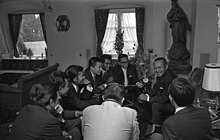
The new president enlisted a grouping of more often than not American-educated Indonesian economists, dubbed the "Berkeley Mafia", to formulate government economic policy. Past cutting subsidies and government debt, and reforming the exchange rate mechanism, inflation dropped from 660% in 1966 to nineteen% in 1969. The threat of famine was alleviated by influx of USAID rice aid shipments in 1967 to 1968.[40]
Realizing the famine of domestic capital capable of re-juvenating growth, Suharto reversed Sukarno's economical autarky policies by opening selected economic sectors of the country to foreign investment nether the new Foreign Investment Law of January 1967 (containing generous tax holidays and gratuitous move of coin). Suharto himself travelled to Western Europe and Nihon in a series of trips to promote investment into Indonesia, starting in the natural resource sector. Among the kickoff foreign investors to re-enter Indonesia were mining companies Freeport Sulphur Visitor and International Nickel Company, after followed by significant investment from Japanese, South Korean, and Taiwanese companies. British-owned businesses nationalized by the Sukarno administration as part of Konfrontasi (including and then-dual-listed Unilever and the British part of besides-and so-dual-listed Purple Dutch/Shell) were reprivatized; yet, Dutch companies originally nationalized in the tardily 1950s-early on 1960s (including just not express to Hollandsche Beton Groep[b], NILLMIJ (by 1969 merged into Ennia, at present Aegon), and the Dutch part of Royal Dutch/Beat) were not reprivatized due to nationalist sentiments.[41] From 1967, the government managed to secure depression-interest foreign aid from ten countries grouped under the Inter-Governmental Grouping on Republic of indonesia (IGGI) to cover its budget arrears.[42]
Suharto'southward government issued the Domestic Investment Police of June 1968 to allow development of a domestic backer form capable of motoring economic growth to supplement existing state-owned enterprises. The late 1960s and early 1970s saw emergence of domestic entrepreneurs (more often than not Chinese-Indonesians) in the import-substitution low-cal-manufacturing sector such equally Astra Group and Salim Group.[43]
Flush with IGGI strange aid and after the jump in oil exports during the 1973 oil crisis, the authorities began a series of large-scale intensive investment in infrastructure nether a series of five-twelvemonth plans (Rencana Pembangunan Lima Tahun / REPELITA):
- REPELITA I (1969–1974) focusing on agricultural improvements (Dark-green Revolution) to ensure nutrient security
- REPELITA 2 (1974–1979) focusing on infrastructure on islands exterior Java and growth in primary industries
- REPELITA III (1979–1984) focusing on achieving nutrient cocky-sufficiency and growth in consign-oriented labour-intensive industry
- REPELITA IV (1984–1989) focusing on growth in capital-skillful manufacturing
- REPELITA V (1989–1994) focusing on growth in telecommunications, education, and transportation infrastructure
- REPELITA Half-dozen (1994–1998, unfinished) focusing on infrastructure to support foreign investment and free trade[43] [44] [45]
While establishing a formal economy based on rational and audio macroeconomic policies, Suharto connected his past modus operandi of creating a vast network of charitable organisations ("yayasan") run by the armed services and his family unit members, which extracted "donations" from domestic and foreign enterprises in commutation for necessary authorities back up and permits. While some proceeds of these organisations were used for genuinely charitable purposes (such as building a heart-disease hospital by Yayasan Harapan Kita run by the get-go lady), most of the coin was recycled equally slush funds to reward political allies to maintain support for Suharto's presidency.[44] [46]
In February 1975, the state oil company Pertamina was forced to default on its United states$xv billion in loans from American and Canadian creditors. The company'south director, Full general Ibnu Sutowo (a close marry of Suharto), invested the windfall income from rising oil prices into a myriad of other business activities such every bit aircraft, steel, construction, real manor, and hospitals. These businesses were mismanaged and riddled with abuse. The government was forced to bond out the company, in the process most doubling the national debt, while Ibnu Sutowo was removed from his position.[47]
Foreign policy [edit]

Upon assuming power, Suharto regime adopted a policy of neutrality in the Cold War with quiet alignment with the Western bloc (including Japan and Republic of korea) with the objective of securing support for Republic of indonesia's economic recovery. Western countries, impressed past Suharto's strong anti-communist credentials, were quick to offer their support. Diplomatic relations with Prc was suspended in October 1967 due to suspicion of Chinese involvement in 30 September Movement (diplomatic relations was only restored in 1990). Due to Suharto'southward destruction of PKI the Soviet Union embargoed war machine sales to Indonesia. Withal, from 1967 to 1970 strange minister Adam Malik managed to secure several agreements to restructure massive debts incurred by Sukarno from the Soviet Union and other Eastern European communist states. Regionally, having concluded confrontation with Malaysia in August 1966, Republic of indonesia became a founding member of the Association of Southeast Asian Nations (Association of southeast asian nations) in August 1967. This organisation is designed to establish a peaceful relationship between Southeast Asian countries costless from conflicts such as the ongoing Vietnam War.[44]
In 1974, the neighbouring colony of Portuguese Timor descended into civil war later the withdrawal of Portuguese authority following the Carnation Revolution, whereby the leftist-leaning Fretilin (Frente Revolucionária de Timor-Leste Independente) emerged triumphant. After persuasion from Western countries (including from US president Gerald R. Ford and Australian prime minister Gough Whitlam during their visits to Indonesia), Suharto decided to arbitrate to prevent establishment of a communist state. Later an unsuccessful attempt of covert back up to Timorese anti-communist groups UDT and APODETI, Suharto authorised a full-calibration invasion of the colony on 7 December 1975 followed with its official annexation as Indonesia's 27th province of East timor in July 1976. The "encirclement and annihilation" campaigns of 1977–1979 bankrupt the back of Fretilin control over the hinterlands, although standing guerilla resistance forced the government to maintain stiff military presence in the half-island until 1999. An estimated minimum of 90,800 and maximum of 213,600 conflict-related deaths occurred in Due east Timor during Indonesian rule (1974–1999); namely, 17,600–xix,600 killings and 73,200 to 194,000 'backlog' deaths from hunger and illness. Indonesian forces were responsible for about lxx% of the violent killings.[48]
Apex of power [edit]
Socio-economical progress and growing corruption [edit]
By 1996, Republic of indonesia's poverty rate had dropped to around 11% compared with 45% in 1970 co-ordinate to some studies, though this claim of poverty reduction is debatable and many studies indicate poverty is much higher than claimed,[49] [l] with equally many as 50% of Indonesians living on a dollar PPP a solar day or less.[51] From 1966 to 1997, Indonesia recorded real GDP growth of five.03% per year, pushing existent GDP per capita upwards from United states of america$806 to US$four,114. In 1966, the manufacturing sector made up less than 10% of GDP (generally industries related to oil and agriculture). By 1997, manufacturing had risen to 25% of GDP, and 53% of exports consisted of manufactured products. The regime invested into massive infrastructure evolution (notably the launch of the Palapa telecommunication satellites); consequently Indonesian infrastructure in the mid-1990s was considered on par with Cathay's. Suharto was bang-up to capitalise on such achievements to justify his presidency, and an MPR resolution in 1983 granted him the title of "Male parent of Evolution".[52]
Suharto's health-intendance programs (such every bit the Puskesmas programme) increased life expectancy from 47 years (1966) to 67 years (1997) and cut the infant mortality rate past more than 60%.[ citation needed ] The government'southward Inpres programme, launched in 1973, resulted in the primary-school enrollment ratio reaching 90% by 1983 while almost eliminating educational activity gap betwixt boys and girls. Sustained back up for agriculture resulted in Indonesia reaching rice self-sufficiency past 1984, an unprecedented achievement which earned Suharto a gold medal from the FAO in November 1985.[53]
In the early 1980s, Suharto responded to the fall in oil exports due to the 1980s oil overabundance by successfully shifting the main pillar of the economy into export-oriented labour-intensive manufacturing, fabricated globally competitive by Republic of indonesia's low wages and a series of currency devaluations. Industrialization was by and large undertaken past ethnic-Chinese companies, which evolved into immense conglomerates, dominating the nation's economy. The largest conglomerates are the Salim Grouping, led past Liem Sioe Liong (Sudono Salim), the Sinar Mas Group, led by Oei Ek Tjong (Eka Tjipta Widjaja), the Astra Group, led by Tjia Han Poen (William Soeryadjaya), the Lippo Grouping, led by Prevarication Mo Tie (Mochtar Riady), the Barito Pacific Group, led by Pang Djun Phen (Prajogo Pangestu), and the Nusamba Grouping, led by Bob Hasan. Suharto decided to support the growth of a minor number of Chinese-Indonesian conglomerates since they could non challenge his rule due to their ethnic-minority condition, and, based on past feel, he thought that they possessed the skills and capital needed to create existent growth for the land. In exchange for Suharto's patronage, the conglomerates provided vital financing for his "regime maintenance" activities.[54]
In the belatedly 1980s, the Suharto regime decided to de-regulate the banking sector to encourage savings and providing domestic source of financing required for growth. Suharto decreed the "October Package of 1988" (PAKTO 88), which eased requirements for establishing banks and extending credit, resulting in a fifty% increase in number of banks from 1989 to 1991. To promote savings, the government introduced the TABANAS ( Tabungan Pembangunan Nasional , National Development Savings) program to the populace. The Jakarta Stock Exchange, originally opened in 1912 as the Batavia (afterwards Jakarta) branch of the Amsterdam Stock Exchange (now Euronext Amsterdam) and re-opened in 1977, performed strongly due to spree of domestic IPOs and an influx of foreign funds subsequently deregulation in 1990.[ commendation needed ] The sudden availability of credit fuelled potent economical growth in the early 1990s, only weak regulation of the fiscal sector sowed the seeds of the catastrophic crisis in 1997 which eventually lead to Suharto'southward resignation.[55]
The growth of the economy was coincided by rapid expansion in corruption, collusion, and nepotism (Korupsi, Kolusi, dan Nepotisme / KKN). In the early on 1980s, Suharto's children, especially Siti Hardiyanti Rukmana ("Tutut"), Hutomo Mandala Putra ("Tommy"), and Bambang Trihatmodjo, grew increasingly venal and corrupt. Their companies were given lucrative authorities contracts and protected from market competition past monopolies. Examples include the Jakarta Inner Ring Road, which Tutut had a majority (75% at one time) pale through her PT Citra Lamtoro Gung Persada subsidiary PT Citra Marga Nusaphala Persada; the national car projection, monopolized by Bambang and Tommy (through the Bimantara Group (at present MNC Grouping)'s joint venture with the Hyundai Motor Company, and Timor Putra Nasional's joint venture with Kia Motors, respectively); the clove industry, monopolized past a Tommy-linked governmental trunk called the Clove Buffering and Marketing Administration (Indonesian: Badan Penyangga dan Pemasaran Cengkeh, BPPC); and even the cinema market place, monopolised past 21 Cineplex, owned by Suharto's cousin Sudwikatmono. The family is said to control virtually 36,000 km² of real estate in Republic of indonesia, including 100,000 m² of prime office space in Dki jakarta and near 40% of the land in Democratic republic of timor-leste. Additionally, Suharto's family unit members received free shares in ane,251 of Indonesia's virtually lucrative domestic companies (more often than not run by Suharto's indigenous-Chinese cronies), while strange-endemic companies were encouraged to establish "strategic partnerships" with Suharto family's companies. Meanwhile, the myriad yayasans run by Suharto family unit grew even larger, levying millions of dollars in "donations" from the public and private sectors each year.[56] [57]
Grip on ability [edit]
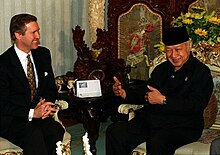
By the 1980s, Suharto'southward grip on power was very strong, maintained past strict control over civil guild, engineered elections, liberal use of military'due south coercive powers, and a stiff economic system.[58] Upon his retirement from the military in June 1976, Suharto undertook a re-organization of the armed forces that concentrated power away from commanders to the president. In March 1983, he appointed General Leonardus Benjamin Moerdani as head of the armed forces. A tough and capable soldier, Moerdani was also a Roman Catholic, which precluded him from posing a political threat to Suharto.[59]
Suharto ruthlessly suppressed elements that disturbed the tranquility of the New Society order. From 1983 to 1985, ground forces death squads murdered up to ten,000 suspected criminals in response to a fasten in criminal offence rate (dubbed "Petrus Killings"). Suharto's imposition of Pancasila as sole ideology caused protests from bourgeois Islamic groups which considered Islamic police (sharia) to be above any human conceptions. In September 1984, a tearing demonstration in the Tanjung Priok surface area of Jakarta by conservative Muslims led to soldiers opening burn, massacring up to 100 protesters. A retaliatory series of minor bombings (notably the bombing of Borobudur Temple in January 1985) led to arrests of hundreds of bourgeois Islamic activists, ranging from hereafter parliamentary leader A. M. Fatwa to radical cleric Abu Bakar Bashir (future founder of terrorist group Jemaah Islamiyah). Attacks on police by the resurgent Libyan-aided Free Aceh Movement in 1989 led to a brutal military operation ("Operasi Jaring Merah") that killed upward to 12,000 people, more often than not civilians, by the time ended the insurgency ended in 1992. More subtly, the Suharto regime sought to better control the press by issuing a 1984 law requiring all media to possess a press operating licence (SIUPP) which could exist revoked at whatsoever time past the Ministry of Information. [60]
In the international arena, Western concern over Communism waned with the end of the Cold State of war, and Suharto's homo-rights record came nether greater international scrutiny. The November 1991 Santa Cruz Massacre in Dili, East Timor, resulted in the United States Congress passing limitations on IMET assistance to the Indonesian Military machine. Suharto retaliated by cancelling purchase orders for American F-16 fighter jets in 1997.[61] [62] When Netherlands condemned the Santa Cruz Massacre, Suharto retaliated past expelling the Dutch from IGGI in March 1992 and renaming it the Consultative Grouping on Indonesia (CGI) which continued increasing aid to Indonesia.[63] Realizing this trend, Suharto sought wider alliances under the rubric of economic development, away from over-reliance to United States back up. Suharto was elected equally head of the Non-Aligned Motion in 1992, while Republic of indonesia became a founding member of APEC, in 1989, and hosted the Bogor APEC Summit in 1994.[64]
Domestically, the growing rapaciousness of Suharto's family created discontent among the military, which lost access to power and lucrative rent-seeking opportunities. In the March 1988 MPR session, armed forces legislators attempted to force per unit area Suharto by unsuccessfully seeking to block the nomination of Sudharmono, a Suharto-loyalist, as vice-president. After General Moerdani voiced his objections on the Suharto family's abuse, the president dismissed him from the position of war machine master. Suharto proceeded to slowly "de-militarize" his regime; he dissolved the powerful Kopkamtib in September 1988 and ensured primal military positions were held by loyalists.[65]
In an attempt to diversify his power base away from the military machine, Suharto began courting support from Islamic elements. He undertook a much-publicized hajj pilgrimage in 1991, took up name of Haji Mohammad Suharto, started promoting Islamic values into society, and promoted the careers of Islamic-oriented generals (dubbed the "green generals"). To win support from the nascent Muslim business customs, which resented dominance of Chinese-Indonesian conglomerates, Suharto formed the Indonesian Clan of Muslim Intellectuals (ICMI) in November 1990, and appointed his protégé B. J. Habibie, Government minister for Research and Applied science since 1978, as its leader. During this catamenia of Suharto'southward cozying with Islamists, race riots confronting ethnic-Chinese began to occur quite regularly, beginning with the April 1994 riot in Medan.[66]
By the 1990s, Suharto'due south government came to be dominated past sycophantic civilian politicians such equally Habibie, Harmoko, Ginandjar Kartasasmita, and Akbar Tanjung, who owed their position solely to Suharto. As a sign of Habibie's growing clout, when three prominent Indonesian magazines—Tempo, DeTIK, and Editor—criticised Habibie's buy of almost the entire armada of the disbanded East German language Navy in 1993, despite most of the vessels having piffling value other than scrap, Suharto ordered the offending publications to be airtight down on 21 June 1994[66] on the pretext that these critiques could "incite conflicts within the cabinet". Tempo would afterward movement to the then-largely-uncensored internet every bit Tempointeraktif (which yet exists today as tempo.co) for the rest of the New Order, and the owner of DeTIK would launch some other mag called DeTAK.
By the 1990s, elements of the growing Indonesian center form, created by Suharto's economic development, were becoming restless with his autocracy and his family's brazen abuse, fuelling demands for "Reformasi" (reform) of the 30-twelvemonth-one-time New Gild system. By 1996, Megawati Sukarnoputri, the girl of Sukarno and chairwoman of the normally compliant PDI, was becoming a rallying point for this growing discontent. In response, Suharto backed a co-opted faction of the PDI led by Suryadi, which removed Megawati from the chair. On 27 July 1996, an set on by soldiers and hired thugs led past Lieutenant-General Sutiyoso on demonstrating Megawati supporters in Jakarta resulted in fatal riots and looting. This incident was followed by waves of arrests on 200 democracy activists, 23 of whom were kidnapped (some were murdered) by army squads called Tim Mawar ("Rose Team") led by Suharto'south son-in-law, Major-General Prabowo Subianto.[67] Regardless of these incidents, every bit late as mid-1997, Suharto's grip on power seemed equally secure as always with the armed services led by his loyalists, all opposition groups suppressed, and the economy in practiced shape.
Downfall [edit]
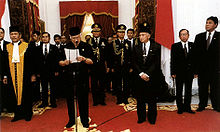
Suharto reads his accost of resignation at Merdeka Palace on 21 May 1998. Suharto's VP and successor, B. J. Habibie, was on his left.
The 1997 Asian financial crisis began in July 1997, in Thailand, and spread into Indonesia equally strange speculative investors pulled out their investments, sucking U.S. dollar liquidity in Indonesia and causing severe depreciation of the Indonesian rupiah. In the private sector, many Indonesian corporations had been borrowing heavily in lower-involvement U.S. dollars, while their revenues were mostly in rupiah; their debt chop-chop increased equally the United states of america dollar appreciated, leaving many companies virtually broke. These companies desperately sold rupiah and bought U.S. dollars, causing the rupiah's value to drop from Rp 2,600 per dollar in Baronial 1997 to over Rp 14,800 per dollar by January 1998. Efforts by the fundamental bank to defend its managed float regime by selling dollars had piddling impact and instead tuckered Republic of indonesia'southward foreign substitution reserves, forcing the regime to free-float the currency and seek liquidity aid from the IMF (International Budgetary Fund).[68]
In exchange for Usa$43 billion in liquidity assistance, Suharto was forced to sign three messages of intent from October 1997 to April 1998 with the Imf. The letters of intent promised reforms, which included endmost banks owned by Suharto's family and cronies starting in Nov 1997. Plans to close unhealthy banks resulted in a depository financial institution run that drained liquidity; depositors knew of the poor regulations and risky related-party credit extensions of Indonesian banks. In January 1998, the government was forced to provide emergency liquidity assist (BLBI), issue a blanket guarantee for bank deposits, and gear up up the Indonesian Bank Restructuring Agency to take over management of troubled banks to forbid the collapse of the financial organisation. Based on International monetary fund recommendations, the regime increased interest rates to 70% in February 1998 to control spiralling aggrandizement caused by the higher cost of imports, but this action killed availability of credit to the corporate sector. Suharto'due south pes-dragging in undertaking reforms demanded by Imf in relation to his children'southward business farther weakened public conviction.[44] [69] According to American economist Steve Hanke, invited past Suharto in February 1998 to programme a currency board organization, President Bill Clinton and Imf managing director Michel Camdessus deliberately worsened the Indonesian crisis to force Suharto to resign.[70]
Economic meltdown was accompanied by increasing political tension. Anti-Chinese riots occurred in Situbondo (1996), Tasikmalaya (1996), Banjarmasin (1997), and Makassar (1997); while bloody ethnic clashes bankrupt out between the Dayak and Madurese settlers in Central Kalimantan in 1997. After violent entrada season, Golkar won the heavily rigged May 1997 MPR elections. The new MPR voted unanimously to re-elect Suharto to some other five-year term in office in March 1998, upon which he proceeded to appoint his protege BJ Habibie as vice-president while stacking the chiffonier with his ain family and business concern associates (his daughter Tutut became Government minister of Social Diplomacy). The regime's decision to increase fuel prices past lxx% on iv May triggered anti-Chinese rioting in Medan. With Suharto increasingly seen as the source of the state's mounting economic and political crises, prominent political figures spoke out against his presidency (notably Muslim politician Amien Rais), and in January 1998 university students began organising nationwide demonstrations.[71]
In West Kalimantan in that location was communal violence between Dayaks and Madurese in 1996, in the Sambas conflict of 1999, and the Sampit conflict of 2001, all of which resulted in big-scale massacres of the Madurese.[72] [73] [74] In the Sambas conflict, both Malays and Dayaks massacred Madurese.
The crisis climaxed when Suharto was on a state visit to Egypt in May 1998. Security forces killed four pupil demonstrators from Djakarta's Trisakti University on 12 May 1998, which was followed by anti-Chinese rioting and looting beyond Jakarta and some other cities on thirteen–15 May that destroyed thousands of buildings and killed over 1,000 people. Various theories exist on the origins of the racial pogrom against the ethnic-Chinese. 1 theory suggested rivalry between military main General Wiranto and Prabowo Subianto, while another theory suggested deliberate provocation past Suharto to divert blame for the crisis to the ethnic-Chinese and discredit the student movement.[75]
On 16 May, tens of thousands of university students occupied the parliament building, demanding Suharto's resignation. Upon Suharto's render to Djakarta, he tried to defend his presidency by offering to resign in 2003 and to reshuffle his chiffonier. These efforts failed when his political allies deserted him past refusing to join the proposed new cabinet. According to military machine chief Wiranto, on xviii May, Suharto issued a prescript which provided dominance to him to take any measures to restore security (like to the 1966 Supersemar), nevertheless Wiranto decided not to enforce the decree to preclude disharmonize with the population.[76] On 21 May 1998, Suharto appear his resignation, upon which vice-president B. J. Habibie assumed the presidency in accord with the constitution.[44] [69] [77]
Notes [edit]
- ^ Presidential Didactics 14 of 1967
- ^ Returned in 1970 every bit Decorient Indonesia; became consolidated subsidiary of HBG in 1977, and was retained by Royal BAM Group following its acquisition of HBG in 2002, until a direction buyout in 2021
- ^ KORPRI withal exists today and all civil servants are even so required to join the corps.
- ^ "Pancasila". U.South. Library of Congress. 3 February 2017. Archived from the original on 5 February 2017. Retrieved 5 February 2017.
- ^ Vickers 2005, p. 117. sfn mistake: no target: CITEREFVickers2005 (help)
- ^ The World Factbook. Fundamental Intelligence Agency. 1992. Retrieved 8 August 2021.
- ^ End talk of KKN Archived 26 October 2014 at the Wayback Automobile. The Jakarta Mail (24 August 2001).
- ^ Schwarz (1994), pages 52–57, Sheriden, Greg (28 Jan 2008). "Farewell to Jakarta's Man of Steel". The Australian. Archived from the original on 6 September 2009. Retrieved thirty December 2008.
- ^ Ricklefs (1991), page 282
- ^ Dake, Antonie (2006). Sukarno Files. Yayasan Obor.
- ^ Ricklefs (1991), pages 272–280
- ^ Robinson, Geoffrey B. (2018). The Killing Season: A History of the Indonesian Massacres, 1965-66. Princeton University Press. p. iii. ISBN9781400888863.
- ^ Melvin, Jess (2018). The Army and the Indonesian Genocide: Mechanics of Mass Murder. Routledge. p. ane. ISBN978-1138574694.
- ^ Vickers (2005), page 160
- ^ Elson, R.E. (2001). Suharto: A Political Biography. Cambridge, United kingdom: Cambridge University Printing. pp. 130–135. ISBN0-521-77326-i.
- ^ McDonald (1980), p. 60.
- ^ Schwartz (1994), folio 2
- ^ Ricklefs (1991), p. 295.
- ^ a b c d Ken Ward. "'2 Soeharto's Javanese Pancasila' in Soeharto'southward New Social club and its Legacy: Essays in honour of Harold Crouch by Edited by Edward Aspinall and Greg Fealy | ANU E Press". Epress.anu.edu.au. Archived from the original on 14 May 2013. Retrieved 6 December 2013.
(Harold Crouch)
- ^ Wanandi, 2012, p. 56-59
- ^ Wanandi, 2012, p. lx-68
- ^ Aspinal (1999), p.ii
- ^ Wanandi, 2012, p. 86-88
- ^ Ricklefs (1982), p.76-77
- ^ Elson (2001), p.184-186
- ^ Schwarz (1992), p. 32
- ^ Schwarz (1992), p.32
- ^ Schwartz (1994), page 106
- ^ Conboy (2003), p. 262-265
- ^ Elson (2001), p. 177-178
- ^ Elson (2001), p. 178-279
- ^ "East timor". world wide web.trincoll.edu. Archived from the original on 7 January 2007. Retrieved 4 May 2014.
- ^ "Mengenal Sosok Intelijen Anti-Islam (3) - Salam Online". salam-online.com. 13 December 2012.
- ^ "Mengenal Sosok Intelijen Anti-Islam (2) - Salam Online". salam-online.com. 8 December 2012.
- ^ "Mengenal Sosok Intelijen Anti-Islam (1) - Salam Online". salam-online.com. 8 December 2012.
- ^ "Jelang Ajal, Sang 'Islam Phobi' Theo Syafei Diserang Kanker Otak Langka - VOA-ISLAM.COM". voa-islam.com.
- ^ "Archived copy". Archived from the original on 24 July 2014. Retrieved 4 May 2014.
{{cite web}}: CS1 maint: archived re-create as title (link) - ^ "Archived copy". Archived from the original on five May 2014. Retrieved 4 May 2014.
{{cite web}}: CS1 maint: archived re-create as title (link) - ^ "Archived re-create". Archived from the original on 5 May 2014. Retrieved 4 May 2014.
{{cite spider web}}: CS1 maint: archived copy as title (link) - ^ "Archived copy". Archived from the original on five May 2014. Retrieved four May 2014.
{{cite web}}: CS1 maint: archived copy as championship (link) - ^ "Archived re-create". Archived from the original on 5 May 2014. Retrieved iv May 2014.
{{cite web}}: CS1 maint: archived copy as title (link) - ^ "Pelarang Jibab 1980-an: Dikeluarkan Sekolah, Jilbab Beracun". two Nov 2019.
- ^ J. Panglaykim and K.D. Thomas, "The New Order and the Economy," Indonesia, April 1967, p. 73.
- ^ Isnaeni, Hendri F. (25 June 2020). "Strategi Unilever Menghadapi Nasionalisasi". historia.id (in Indonesian). Retrieved xi July 2021.
- ^ Elson (2001), p. 170-172
- ^ a b Robinson (2012), p. 178-203
- ^ a b c d eastward McDonald, Hamish (28 January 2008). "No End to Appetite". Sydney Morning Herald.
- ^ Sheridan, Greg (28 Jan 2008). "Farewell to Djakarta'southward Human being of Steel". The Australian . Retrieved fourteen April 2010.
- ^ Koerner, Brendan (26 March 2004). "How Did Suharto Steal $35 Billion? Cronyism 101". Slate . Retrieved four February 2006.
- ^ Schwatrz (1994)
- ^ Benetech Human Rights Data Analysis Group (nine Feb 2006). "The Profile of Human Rights Violations in Timor-Leste, 1974–1999". A Report to the Commission on Reception, Truth and Reconciliation of Timor-Leste. Man Rights Data Analysis Group (HRDAG). Archived from the original on 29 May 2012.
- ^ Stay informed today & every day (14 September 2006). "Poverty in Indonesia: Always with them". The Economist. Retrieved six December 2013.
- ^ "Poverty In Indonesia - Poverty and Education". Povertyindonesia.com. Archived from the original on 7 January 2014. Retrieved 6 December 2013.
- ^ "Poverty Rises With Wealth in Republic of indonesia - Inter Press Service". Ipsnews.net. 29 June 2012. Retrieved 6 December 2013.
- ^ Stone (2003), p.iii
- ^ Stone (2003), p.4
- ^ Rock, Michael T., "The Politics of Development Policy and Development. Policy Reform in New Order Indonesia", William Davidson Establish, University of Michigan business school, November 2003.
- ^ http://world wide web.bi.go.id/NR/rdonlyres/A6011CBA-1B4E-49B1-9DDC-CB01AB6C60D0/19386/SejarahPerbankanPeriode19831997.pdf Archived viii April 2011 at the Wayback Machine; "Sejarah Bank Indonesia : Moneter. Periode 1983-1997" (pdf/mayhap aforementioned document/non in English language), Unit Khusus Museum Banking concern Indonesia.
- ^ "Suharto tops abuse rankings". BBC News. 25 March 2004. Retrieved four February 2006.
- ^ "Global Corruption Report" (PDF). Transparency International. Archived from the original (PDF) on iv July 2007. Retrieved 6 August 2009.
- ^ Ricklefs, Merle Calvin (2001). A History of Modern Indonesia Since C. 1200. Stanford, CA: Stanford Academy Press. pp. 342–387. ISBN9780804744805.
- ^ Elson (2001), p.457-460
- ^ Aspinal (1999), pp. ii–three
- ^ "H.AMDT.647 (A003): An amendment to prohibit whatsoever funds appropriated in the bill to exist used for military education and training assistance to Republic of indonesia". THOMAS (Library of Congress). Archived from the original on 13 January 2016. Retrieved 4 Feb 2006.
- ^ "United Nations Loftier Committee on Human Rights resolution 1993/97: State of affairs in East Timor". United Nations. Retrieved 4 February 2006.
- ^ Elson (2001), p.501-503
- ^ Elson (2001), p.510-511
- ^ Pour (2007), p.242-264
- ^ a b Elson (2001), p.211-214
- ^ Elson (2001), p. 284-287
- ^ Enoch, Charles, Barbara Baldwin, Olivier Frécaut, and Arto Kovanen, "Indonesia: Beefcake of a Banking Crisis. Two years of living dangerously 1997-99", Imf, May 2001.
- ^ a b Vickers (2005), pp. 203–207.
- ^ "On the Fall of the Rupiah and Suharto | Cato Institute". Cato.org. 27 January 2007. Retrieved 6 Dec 2013.
- ^ Elson (2001), p.267
- ^ "404 Error - Page Non Establish". ploughshares.ca. Archived from the original on 26 February 2020. Retrieved 25 February 2014.
- ^ Dayak
- ^ THE Relationship Betwixt DAYAK AND MADURA IN RETOK by Yohanes Supriyadi Archived 24 March 2012 at the Wayback Machine
- ^ Purdey (2006), p.148-150
- ^ Wiranto (2003), p.67-69
- ^ East. Aspinall, H. Feith, and G. Van Klinken (eds) The Final Days of President Suharto, Monash Asia Establish, pp.4-vii.
References [edit]
- Due east. Aspinall, H. Feith, and G. Van Klinken (eds) (1999). The Final Days of President Suharto. Clayton, Victoria, Australia: Monash Asia Institute. ISBN0-7326-1175-Ten. CS1 maint: multiple names: authors list (link)
- Camdessus Commends Indonesian Deportment. Press Release. Imf. (31 October 1997)
- Colmey, John (24 May 1999). "The Family Firm". Time Asia. Archived from the original on viii February 2001.
- Hill, Hal (1994) in Indonesia's New Order: The Dynamics of Socio-economic Transformation (Ed, Hal Loma), Allen & Unwin, Australia, ISBN 1-86373-229-2 pp56–57
- Berth, Anne and Peter McCawley (eds) 1981. The Indonesian economy during the Soeharto Era, Oxford University Press, Kuala Lumpur. ISBN 0-19-580477-v
- "Indonesia: Arrests, torture and intimidation: The Government's response to its critics". Immunity International. 27 Nov 1996. Archived from the original on ix November 2005.
- "Indonesia Economic". Commanding Heights . Retrieved 23 May 2005.
- "Public Expenditures, Prices and the Poor". World Depository financial institution. 1993. Archived from the original on 23 March 2007.
- Ricklefs, One thousand. C. (1991). A History of Modern Indonesia since c. 1300, 2d Edition. MacMillan. ISBN0-333-57689-6.
- Simpson, Brad (9 July 2004). "Indonesia'due south 1969 Takeover of West Papua Not by "Gratis Selection"". National Security Archive. `
- "Tapol Troubles: When Volition They End?". Inside Indonesia. Apr–June 1999. Archived from the original on 25 May 2000.
- Toer, Pramoedya Ananta (2000). The Mute's Soliloquy : A Memoir. Penguin. ISBN0-fourteen-028904-half dozen.
- Wanadi, Jusuf (2012). Shades of Grey: A Political Memoir of Modern Republic of indonesia 1965-1998. Equinox publishing, Singapore. ISBN978-979-378-092-iv.
Further reading [edit]
- Watson, C.W. (Nib), Of Self and Injustice. Autobiography and Repression in Modernistic Republic of indonesia, Leiden 2006, KITLV, ISBN 9971-69-369-0
- McGregor, Katharine East., History in Uniform. Military Credo and the Structure of Indonesia's By, Leiden 2007, KITLV, ISBN 978-9971-69-360-2
External links [edit]
- Oral History Collection In Search of Silenced Voices at the International Found of Social History — Collection of interviews with Indonesian exiles, on political roles and personal experiences before and after thirty September 1965.
Source: https://en.wikipedia.org/wiki/New_Order_%28Indonesia%29
0 Response to "Peter Vintage Car Restoration Dan Contract $100000 Art June 1"
Post a Comment